THE HASLAM HYPOTHESIS
Specific and testable.
Disputed and unproven.
This page explains the hypothesis in its proponents’ terms, identifies evidence that could confirm or refute it, and gives serious competing explanations their proper weight.
WHAT IT CLAIMS
A proposed human route connected to experimental fieldwork
Rather than proposing simply that an engineered virus escaped from a Wuhan laboratory, Jim Haslam believes the evidence warrants investigating whether Australian virologist Danielle Anderson may have inadvertently become the human vector for the outbreak while participating in work connected to an experimental bat-vaccination effort.
This is Haslam’s hypothesis—not an established finding of CarolinaFlu.org, a court, a government agency, or the scientific community. Publicly available evidence does not presently establish that Anderson was infected, transmitted SARS-CoV-2, or participated in the precise chain of events the hypothesis proposes.
HOW IT COULD BE TESTED
Records should decide whether the proposed sequence is possible.
A useful hypothesis must risk being disproved. These record categories could support, narrow, or contradict Haslam’s account.
DOCUMENTED CONTINUITY AFTER DEFUSE
After DARPA’s rejection, the collaborators remained in contact about another federal proposal.
These reproduced records connect the DEFUSE correspondence, an October 2018 meeting in Wuhan, and a follow-on grant discussion involving UNC’s Ralph Baric.
A March 23, 2018 email in the PREEMPT/DEFUSE chain asked Baric to draft language addressing federal guidance on potential gain-of-function research because “your work in DEFUSE involves this.” On October 21, Baric, Peter Daszak, Linfa Wang and Zhengli Shi attended the same international symposium on emerging viral diseases in Wuhan. The following afternoon, Baric emailed Daszak that it had been “nice seeing you this past week” and asked him to help assemble paperwork for an R01 proposal.
The documents are significant because they show that DARPA’s rejection did not end communication among key collaborators or discussion of another federal funding route. They support asking whether any part of the rejected research agenda was later proposed, funded or pursued through a different grant or institutional arrangement. A separate June 2019 email discusses reused DARPA text in a CREID draft; read both records in the Evidence Library →
View Jim Haslam’s documentary thread ↗Explore the public-records archive ↗
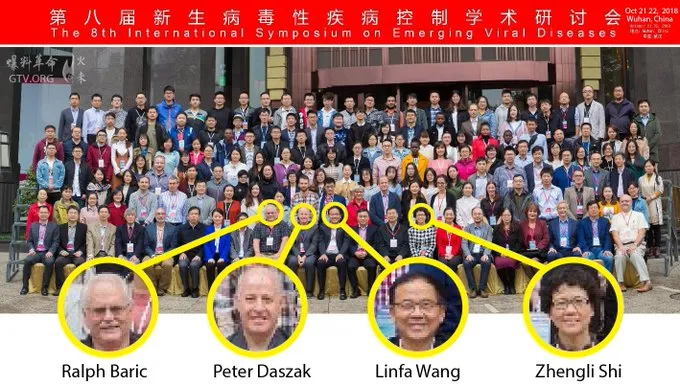
The supplied photograph identifies Baric, Daszak, Wang and Shi among attendees at the 8th International Symposium on Emerging Viral Diseases. The event banner gives the dates and location as October 21–22, 2018, Wuhan, China.
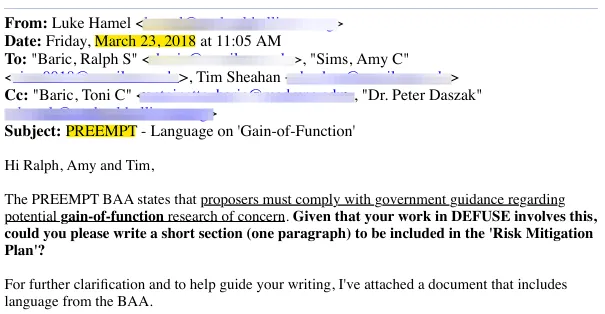
Luke Hamel asks Baric to prepare language responding to federal guidance on potential gain-of-function research, writing that Baric’s work in DEFUSE “involves this.”
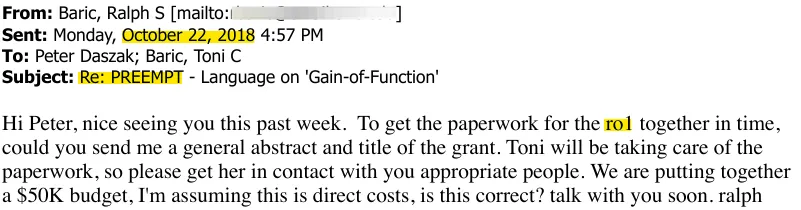
Using the PREEMPT email chain, Baric tells Daszak it was nice seeing him the previous week and asks for help preparing an abstract, title, contact and budget for an R01.
The images above are reproduced from screenshots supplied to CarolinaFlu.org. Higher-resolution originals and complete email chains will replace them when obtained. Email addresses have been obscured in the supplied copies.
WHAT CRITICS ARGUE
The public record leaves substantial reasons for doubt.
Scientists favoring zoonotic origin point to the clustering of early known cases around Wuhan’s Huanan market, the sale of susceptible mammals there, and early viral lineage patterns they interpret as evidence of multiple animal-to-human introductions.
Critics of Haslam’s hypothesis can also reasonably note that no publicly established medical record demonstrates Anderson carried SARS-CoV-2 before the recognized outbreak, no publicly released chain-of-custody evidence connects her to a pandemic progenitor, and viral sequence analysis alone cannot establish the proposed travel-and-transmission route.
THE REQUEST DOES NOT DEPEND ON THIS THEORY
Transparency matters whichever explanation proves correct.
CarolinaFlu.org’s central request is not that UNC endorse Haslam’s hypothesis. It is that relevant records be preserved, independently examined, and lawfully released. Those records could support the hypothesis, refute it, or point toward a different explanation. Each outcome would advance public understanding.